
Infrared welding is an important thermal joining technology used in modern filter cartridge manufacturing. It provides a non-contact heating method for bonding compatible thermoplastic components, particularly in pleated filter cartridge end cap welding.
For manufacturers producing liquid filtration cartridges, welding quality plays an important role in product integrity, assembly consistency, and production efficiency. Understanding how infrared welding works can help manufacturers select suitable equipment and establish reliable welding processes.
1. What Is Infrared Welding?
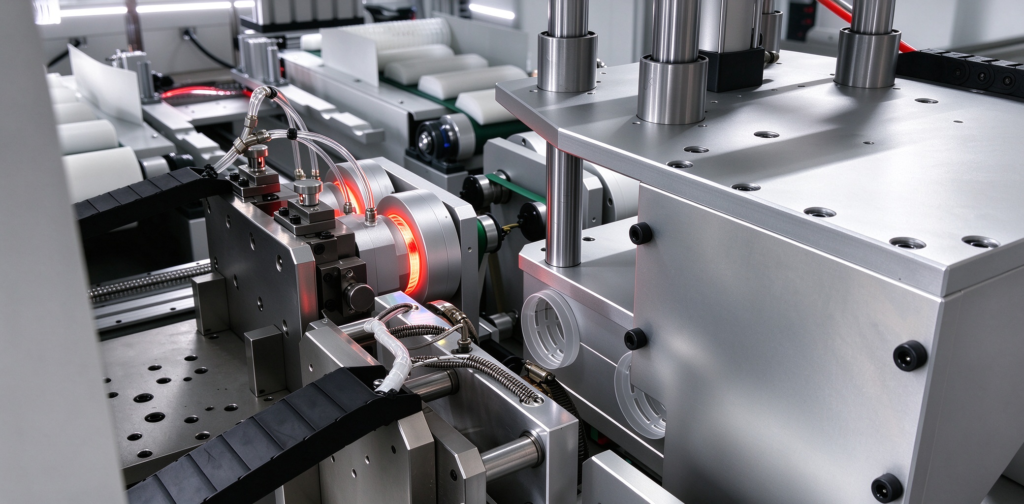
Infrared welding is a thermal joining process that uses infrared radiation to heat the joining surfaces of thermoplastic components without direct contact with the heating element.
During welding, infrared heating elements transfer radiant energy to the surfaces that need to be joined. Once the materials reach suitable welding conditions, the components are brought together under controlled pressure to form a bonded joint.
Unlike conventional hot-plate welding, where the material directly contacts a heated plate, infrared welding uses non-contact heating. This can reduce material sticking to heating surfaces and provide flexibility in controlling the heating process.
The effectiveness of infrared welding depends on material properties, heating element design, exposure time, joining pressure, and component geometry.
2. How Does Infrared Filter Cartridge End Cap Welding Work?
In pleated filter cartridge manufacturing, infrared welding is commonly used to connect thermoplastic end caps to filter cartridge assemblies.
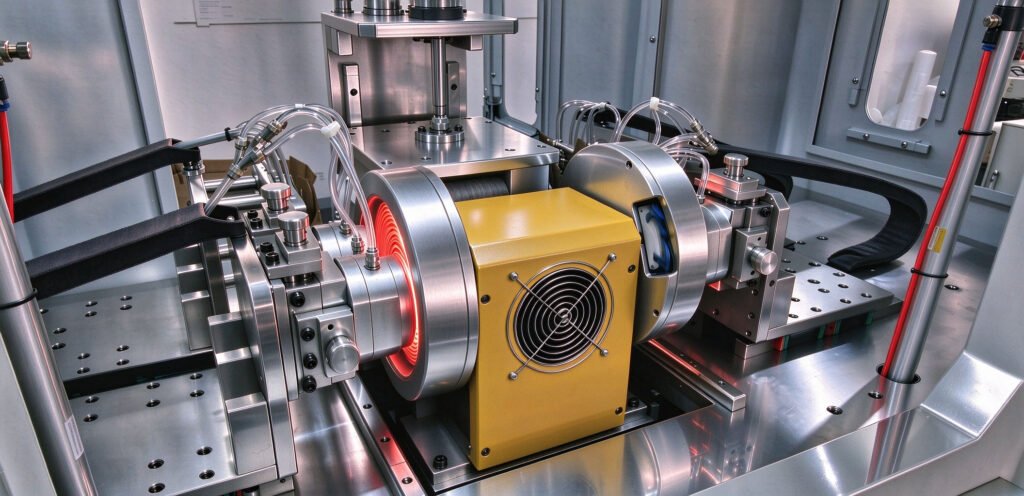
The process generally involves five stages.
Step 1: Component Positioning
The pleated filter cartridge and its end cap are positioned in dedicated fixtures. Accurate alignment is essential for achieving consistent contact between the joining surfaces.
Step 2: Infrared Heating
The infrared heating system moves into the heating position, or the components are positioned near the heating element.
Radiant energy heats the designated joining surfaces, allowing compatible thermoplastic materials to soften or melt.
Step 3: Heating Completion
After the programmed heating period, the heating system moves away from the welding area.
The heated components must be joined within a suitable time window to prevent excessive cooling before bonding.
Step 4: Joining and Pressure Application
The filter cartridge and end cap are brought together under controlled pressure.
The softened thermoplastic surfaces form a welded connection as the materials contact and consolidate.
Step 5: Cooling and Weld Inspection
The welded assembly is allowed to cool sufficiently before removal or further handling.
Manufacturers may inspect the joint appearance and perform suitable mechanical or integrity tests according to their product requirements.
3. Main Advantages of Infrared Welding
Non-Contact Heating
Infrared heating does not require direct contact between the heating element and the thermoplastic joining surface.
This helps reduce the possibility of melted material adhering to the heater and can simplify certain cleaning and maintenance requirements.
Adjustable Welding Parameters
Infrared welding equipment can provide adjustable heating time, heater output, positioning, and joining parameters.
These adjustments help manufacturers establish suitable process conditions for different filter cartridge structures and materials.
Consistent Welding Operations
With suitable fixtures, controlled heating, and repeatable machine movements, infrared welding can support consistent assembly operations.
However, welding quality still depends on appropriate process settings, material compatibility, and equipment maintenance.
Flexible Equipment Configuration
Infrared welding systems can be designed for different filter cartridge diameters, lengths, and end cap configurations.
Customized fixtures and heating arrangements may be required for specialized cartridge structures.
4. Which Filter Cartridges Can Use Infrared Welding?
Infrared welding is suitable for selected thermoplastic filter cartridge assemblies, depending on their material properties and joint design.
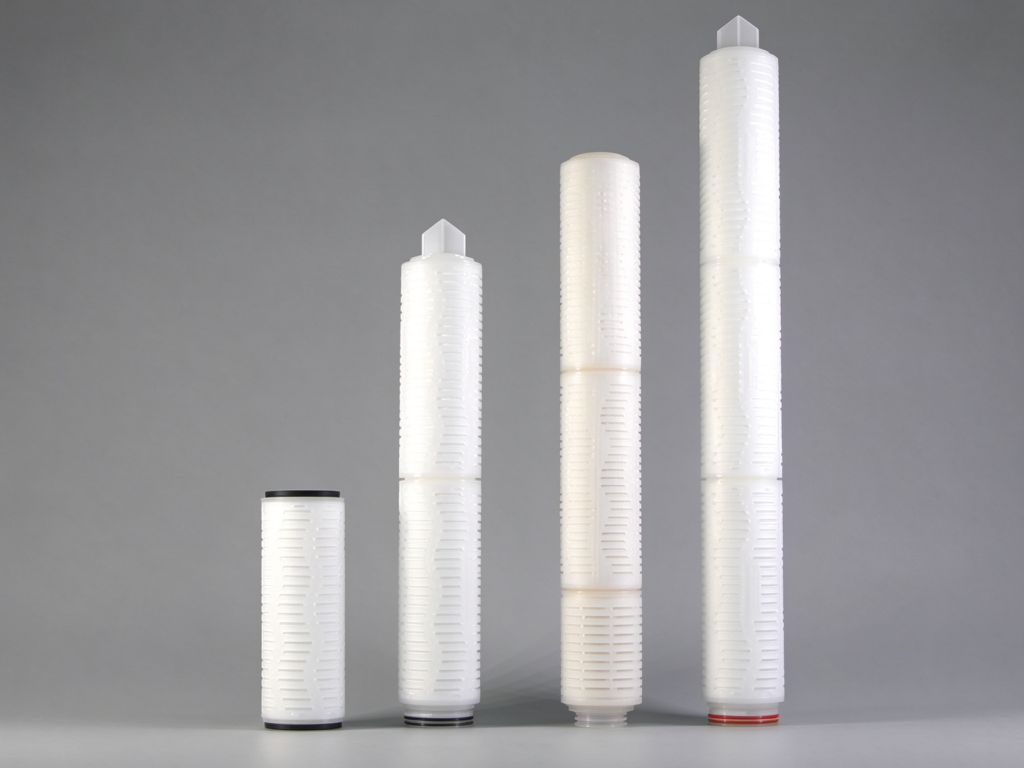
Pleated Filter Cartridges
Infrared end cap welding is used for compatible pleated filter cartridges manufactured for industrial liquid filtration applications.
High Flow Filter Cartridges
Certain high flow filter cartridge designs can use customized infrared welding equipment for end cap assembly.
Large-diameter cartridges may require specialized positioning fixtures and heating configurations.
Specialized Filter Cartridge Designs
Other thermoplastic filter assemblies may also be suitable for infrared welding when their materials, dimensions, and joining structures support the process.
Not every filter cartridge is suitable for infrared welding. Material compatibility and joint design should be evaluated before selecting the equipment.
5. Infrared Welding vs. Hot-Plate Welding
Infrared welding and hot-plate welding are both thermal joining technologies, but their heating methods differ.
Infrared welding transfers radiant energy without direct contact between the heating element and the joining surface.
Hot-plate welding transfers heat through direct contact with a heated surface.
Infrared welding may be advantageous where non-contact heating is preferred, while hot-plate welding remains suitable for many thermoplastic assemblies, including certain capsule filter components.
The appropriate method depends on the cartridge structure, material properties, welding requirements, and production conditions.
6. Why Is Temperature Management Important?
Thermal management is an important consideration in infrared welding equipment, particularly during repeated production cycles.
Excessive heat accumulation around heating assemblies can affect machine operating conditions and process stability.
INDRO has developed an updated infrared heating system with water cooling for compatible filter cartridge end cap welding applications.
The water-cooling arrangement helps manage excess heat in designated machine components, supporting more stable operating conditions during repeated welding cycles.
Combined with suitable heating parameters and accurate positioning, this technology can help manufacturers establish repeatable welding processes.
7. How to Select an Infrared Filter Cartridge Welding Machine
Before purchasing an infrared welding machine, manufacturers should evaluate several factors:
- Filter cartridge dimensions: Outer diameter, inner diameter, and overall length.
- Thermoplastic materials: End cap material, support components, and other materials involved in the welded joint.
- End cap configuration: Flat end caps, DOE, 222, 226, and other compatible designs.
- Production capacity: Required cartridges per hour or per day.
- Welding requirements: Joint geometry, positioning accuracy, and applicable product quality tests.
- Equipment configuration: Manual, semi-automatic, or automated operation, depending on the application.
Providing these specifications helps equipment suppliers recommend a suitable machine configuration and evaluate whether customized tooling is necessary.
8. INDRO Infrared Filter Cartridge Welding Solutions
INDRO specializes in filter cartridge manufacturing equipment, including infrared end cap welding machines and customized welding systems.
Our equipment solutions support compatible pleated and high flow filter cartridge manufacturing applications.
INDRO’s updated infrared heating technology with water cooling is designed to improve thermal management and support stable welding operations.
We also provide application-specific equipment configurations, process guidance, operator training, and technical support for filter cartridge manufacturers.
Conclusion
Infrared welding provides a non-contact thermal joining method for compatible thermoplastic filter cartridge components.
Its advantages include adjustable heating parameters, reduced direct contact with molten materials, and flexibility for different cartridge configurations.
For manufacturers considering infrared end cap welding equipment, selecting suitable technology, fixtures, and process parameters is essential for achieving reliable assembly results.
Looking for an infrared filter cartridge end cap welding machine?
Contact INDRO to discuss your cartridge dimensions, materials, end cap designs, and production requirements. Our team can help you evaluate a suitable welding solution for your manufacturing process.
Need a Filter Cartridge Welding Solution?
Contact INDRO to discuss your filter cartridge dimensions, materials, welding requirements, and production capacity. Our team can help you evaluate a suitable welding machine for your application.